
Or try searching by Category and/or Location

History and nature
Þingvellir National park
As one of the most important places in Icelandic history. In the year 930 the Alþingi, one of the oldest parliamentary institutions of the world, was founded. As a national park (since 1928) because of the special tectonic and volcanic environment.
More details

Nature
Geysir Geothermal area
One of the greatest natural attractions of Iceland and part of the famous "Golden Circle Tour", The Great Geysir, or Stori-Geysir, has been dormant since 1916 when it suddenly ceased to spout. It came to life only once in 1935, and as quickly went back to sleep. The attraction of the area is now Strokkur (The Churn), another geyser 100 meters south of the Great Geysir, which erupts at regular intervals every 10 minutes or so and its white column of boiling water can reach as high as 30 meters.
Read more

Nature
Gullfoss waterfall
Gullfoss is actually two separate waterfalls, the upper one has a drop of 11 metres and the lower one 21 metres. The rock of the river bed was formed during an interglacial period.
Find out more

Reynisfjara Black sand beach
On Reynisfjöru beach, very beautiful basalt formations in the south part of the mountain can be seen, and there you will find an exceedingly beautiful cave called Hálsanefshellir.
Read more

Vestrahorn Mountain
One of the first settlement farms in Iceland was Horn, built by Hrollaugur son of Rögnvaldur. The Hornafjörður Municipality and other sites are named it. Horn means the same thing in Icelandic and English. At Stokksnes you can feel the power of the Atlantic Ocean as the waves hit the rocky shore with massive force.
Read more

Vatnajökull National park
The south side of Vatnajökull is characterised by many high, majestic mountain ridges, with outlet glaciers descending between them onto the lowlands. The southernmost part of the glacier envelops the central volcano Öræfajökull and Iceland's highest peak, Hvannadalshnúkur.
Read more

Skógafoss Waterfall
The greatest attraction of Skógar is of course the beautiful 60-metre high Skogáfoss waterfall in the river Skógá. If the sun conditions are favourable - one can see a vivid rainbow in front of the waterfalls.
Read more
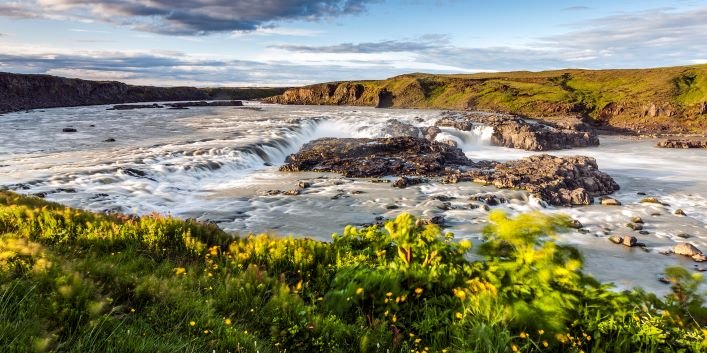
Urriðafoss Waterfall
Urriðafoss is a waterfall in Þjórsá River. Þjórsá is Iceland’s longest river, 230 km, and Urriðafoss is the most voluminous waterfall in the country. This mighty river drops down (360 m3/sec) by the edge of Þjórsárhraun lava field in beautiful and serene surroundings. Þjórsárhraun lava field is the result of the greatest lava flow on earth since the Ice Age. Located right off highway 1.
Read more

Fjaðrárgljúfur Canyon
Fjaðrárgljúfur is a magnificent and massive canyon, about 100 meters deep and about two kilometres long. The canyon has sheer walls, and is somewhat serpentine and narrow. The bedrock in Fjaðrárgljúfur is mostly palagonite from cold periods of the Ice Age and is thought to be about two million years old. The river Fjaðrá has its source in the mountain Geirlandshraun and falls off the heath edge in this stunning canyon until it makes it down into Skaftá river.
Read more

Landmannalaugar Nature reserve
Landmannalaugar derives its name from a hot pool that rises from under the Laugahraun lava field. Landmannalaugar has been a stopping point for people for centuries, and the mountain shepherds on Landmannaafréttur have stayed there while herding sheep off the mountain for as long as there have been reports of such travel.
Read more

Dyrhólaey Nature reserve
Dyrhólaey is a 120-metre high promontory, not far from Vík. The place got its name from the massive arch that the sea has eroded from the headland. (The name literally means "door-hole"). When the sea is calm, big boats can sail through it. There has even been a maniacal daredevil pilot that flew through the arch with a small-craft airplane! From the top of Dyrhólaey there is a great view.
Read more

Seljalandsfoss Watarfall
A unique waterfall in the river Seljalandsá, about 30 km west from Skógar. It is 60 meters high with a footpath behind it at the bottom of the cliff, but with a thin cascade. It is the only known waterfall of its kind, where it is possible to walk behind it. The waterfall is very picturesque and therefore its photo can be found in many books and calendars.
Read more

Katla UNESCO Global Geopark
Katla Geopark includes geological features of global significance. Over 150 volcanic eruptions have been recorded in the area since the 9th century. The eruptions created the landscape and influenced where people settled. Through the centuries, man and nature have affected the region’s history. The area is constantly changing due to volcanic activity.
Read more

Jökulsárlón Glacier lagoon
Jökulsárlón is a glacial lagoon which still blue waters are a sight not to be missed, as it is dotted with the icebergs from the edge of Breiðamerkurjökull. The lagoon flows through a narrow gateway into the Atlantic Ocean, leaving the spectacular sight of the large chunks of ice on the black sandy beach.
Read more