
What is a lopapeysa?
The lopapeysa is Iceland’s traditional wool sweater, knitted from lopi and recognised by the patterned circular yoke around the neck and shoulders. The name simply means “lopi sweater”. Worn by farmers, children, musicians and grandparents alike, it is as much a part of everyday life as it is a symbol of the country.
A younger tradition than you might think
Although Icelanders have knitted for centuries, the lopapeysa as we know it only took shape in the mid-20th century. In the years after independence in 1944, knitters looked for new ways to use native wool, and the sweater grew into a quiet emblem of national identity.
Knitting historians have traced the circular yoke to Nordic patterns from the 1930s, which were themselves inspired by the beaded collars of Greenlandic dress. Icelandic knitters adapted the idea, and over the decades it became distinctly their own.
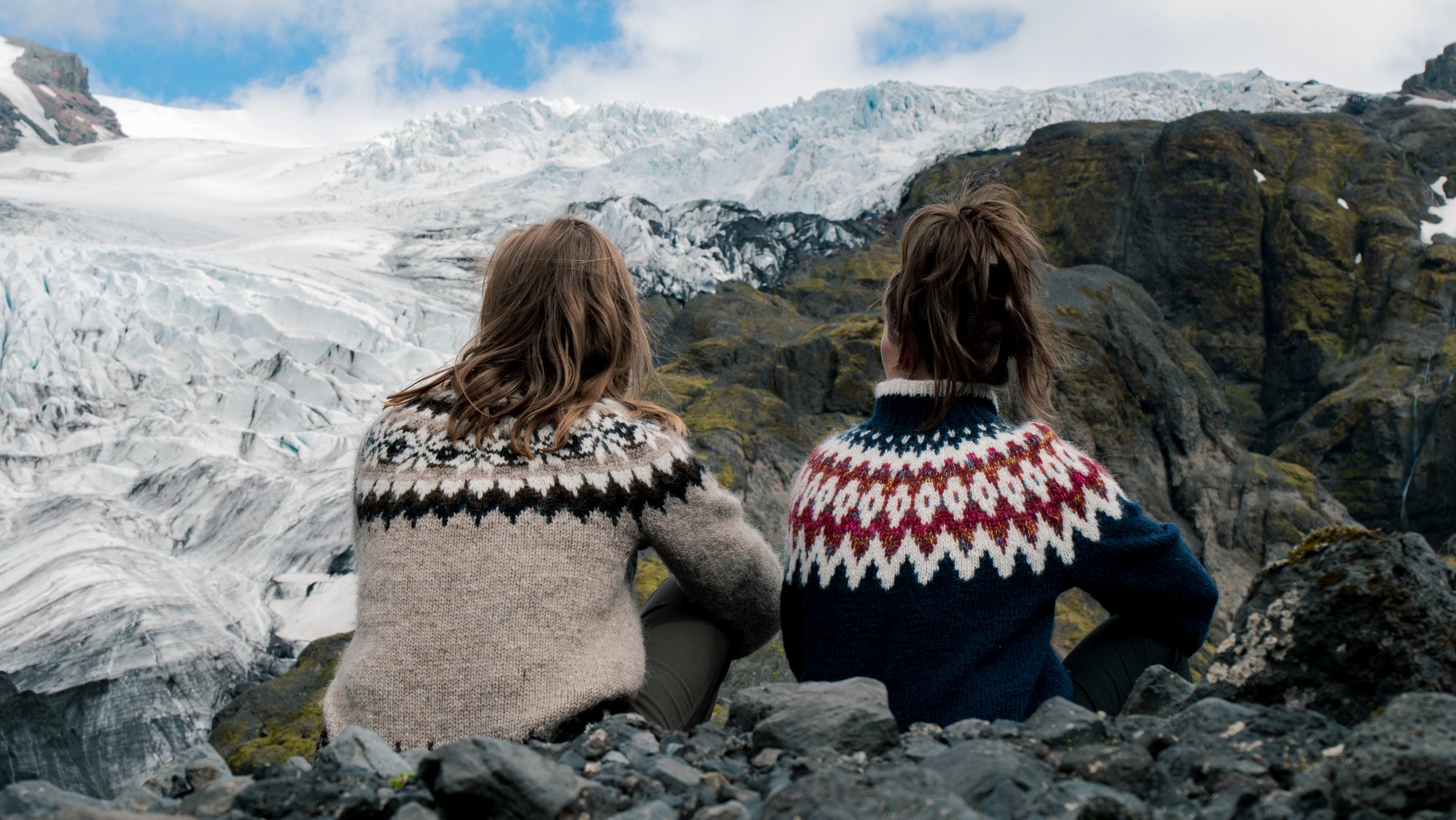
How it is made
A traditional lopapeysa is knitted in the round, so the body and sleeves are tubes without side seams. The pieces are joined at the underarms and the yoke is worked upwards in one piece, with the pattern decreasing towards the neck. Many are made as pullovers, while cardigans are often knitted in the round and then cut open down the front.
Patterns vary widely. Some knitters follow classic designs, while others create their own, drawing on the landscape, the seasons or simply the colours at hand.
How to recognise an authentic lopapeysa
Sweaters in Icelandic style are sold all over the world, but not all of them are knitted in Iceland or from Icelandic wool. “Íslensk lopapeysa” is now a protected name in Iceland, reserved for sweaters hand-knitted in Iceland from Icelandic wool. A few things to look for:
- A label stating Icelandic wool and hand-knitted in Iceland
- A shop that can tell you who knitted it
- A seamless body knitted in the round
- A price that reflects many hours of handwork
Caring for your sweater
A lopapeysa needs little care if treated gently.
- Air it rather than wash it. Wool naturally resists dirt and odour, so hanging it outside often does the job.
- Wash by hand when needed, in lukewarm water with wool soap, without rubbing or wringing.
- Dry it flat on a towel, shaping it by hand.
- Expect some fuzz. Light pilling is natural and can be removed gently.